Bringing anatomy to life: the role of clinical ultrasound in undergraduate medical education – a systematic review
Keywords:
Clinical ultrasound, Anatomy learning, Medical student, Curriculum, Educational outcomeAbstract
Background: The implementation of ultrasound as point-of-care technique within the medical education has been broadly studied to understand its applicability in clinical settings. More research has been conducted to specifically understand the use of clinical ultrasound in the medical curriculum to learn anatomy. The results of publications on anatomical skills and knowledge outcomes of students related to ultrasound are contradictory. The objectives of this study were to identify and describe common study types and educational programs conducted in anatomy teaching with clinical ultrasound and to describe the impact on learning outcomes.
Methods: A literature search from the databases Scopus, PubMed and Google scholar was conducted with keywords related to anatomy learning, ultrasound and medical education. Data from publications were extracted following quantitative and qualitative methods previously described in the literature and adapted to measure the educational outcome.
Results: In total, 1615 records were detected within all three databases after removing duplicates, 194 were found relevant to the topic and included in the review. Of 194, 128 articles were original studies categorized by their study types and outcomes. A large proportion of the studies were conducted at a single institute, and students were mainly evaluated with post-tests only or with pre- and post-tests. Vascular and cardiac anatomical landmarks were the most frequently instructed areas with ultrasound while ocular and prostate/testicular landmarks were the least. Students agreeing to participate in the ultrasound training were highly motivated and described the sessions as valuable for future clinical practice. The evaluation of anatomical knowledge and skills of students following ultrasound training varied widely, and no clear consensus emerged. Long-term assessments of ultrasound-related anatomy competencies were notably underrepresented in the reviewed studies.
Conclusions: The use of clinical ultrasound in undergraduate anatomy education is implemented through diverse teaching formats and is widely appreciated by medical students. However, standardized methods to assess anatomical understanding of medical students through ultrasound are lacking, impeding the comparison of educational outcomes across studies. Further research is needed to evaluate the long-term retention of skills and knowledge to better determine the effectiveness of ultrasound-based teaching.
References
1. Estai M, Bunt S (2016) Best teaching practices in anatomy education: a critical review. Ann Anat 208:151–157. https://doi.org/10.1016/j.aanat.2016.02.010
2. Asad MR, Al Mutairi A, AlZahrani RE, Ahmed MM, Nazeer M, Taha M (2023) Role of living anatomy in medical education: a narrative review. J Pharm Bioall Sci 15:843–845. https://doi.org/10.4103/jpbs.jpbs_235_23
3. Jones R, Higgs R, de Angelis C, Prideaux D (2001) Changing face of medical curricula. Lancet 357:699–703. https://doi.org/10.1016/S0140-6736(00)04134-9
4. Quintero GA, Vergel J, Arredondo M, Ariza MC, Gómez P, Pinzon-Barrios AM (2016) Integrated medical curriculum: advantages and disadvantages. J Med Educ Curric Dev 3 JMECD S18920. https://doi.org/10.4137/jmecd.s18920
5. Smith CF, Barfoot S (2021) Implementation of ultrasound in anatomy education. In: Rea PM (ed) Biomedical visualisation. Advances in experimental medicine and biology, 1317. Springer, Cham. https://doi.org/10.1007/978-3-030-61125-5_6.
6. Shapiro RS, Ko PP, Jacobson S (2002) A pilot project to study the use of ultrasonography for teaching physical examination to medical students. Comput Biol Med 32:403–409. https://doi.org/10.1016/s0010-4825(02)00033-1
7. Hoppmann RA, Mladenovic J, Melniker L, Badea R, Blaivas M, Montorfano M et al (2022) International consensus conference recommendations on ultrasound education for undergraduate medical students. Ultrasound J 14. https://doi.org/10.1186/s13089-022-00279-1
8. Cantisani V, Dietrich CF, Badea R, Dudea S, Prosch H, Cerezo E et al (2016) EFSUMB statement on medical student education in ultrasound [long version]. Ultrasound Int Open 2:2–7. https://doi.org/10.1055/s-0035-1569413
9. EFSUMB European Federation of Societies for Ultrasound in Medicine and Biology Guidelines and Recommendations https://efsumb.org/ Accessed 03 Apr 2025
10. Kenny EJG, Makwana HN, Thankachan M, Clunie L, Dueñas AN (2022) The use of ultrasound in undergraduate medical anatomy education: a systematic review with narrative synthesis. Med Sci Educ Vol 42:1195–1208. Springer Nature10.1007/s40670-022-01593-y
11. McCormick E, Flanagan B, Johnson CD, Sweeney EM (2023) Ultrasound skills teaching in UK medical education: a systematic review. Clin Teach 20:e13635. https://doi.org/10.1111/tct.13635
12. Johnson CD, Davison L, Graham EC, Sweeney EM (2025) Ultrasound technology as a tool to teach basic concepts of physiology and anatomy in undergraduate and graduate courses: a systematic review. Adv Physiol Educ 49:11–26. https://doi.org/10.1152/advan.00199.2023
13. Reed DA, Cook DA, Beckman TJ, Levine RB, Kern DE, Wright SM (2007) Association between funding and quality of published medical education research. J Am Med Assoc 298:1002–1009. https://doi.org/10.1001/jama.298.9.1002
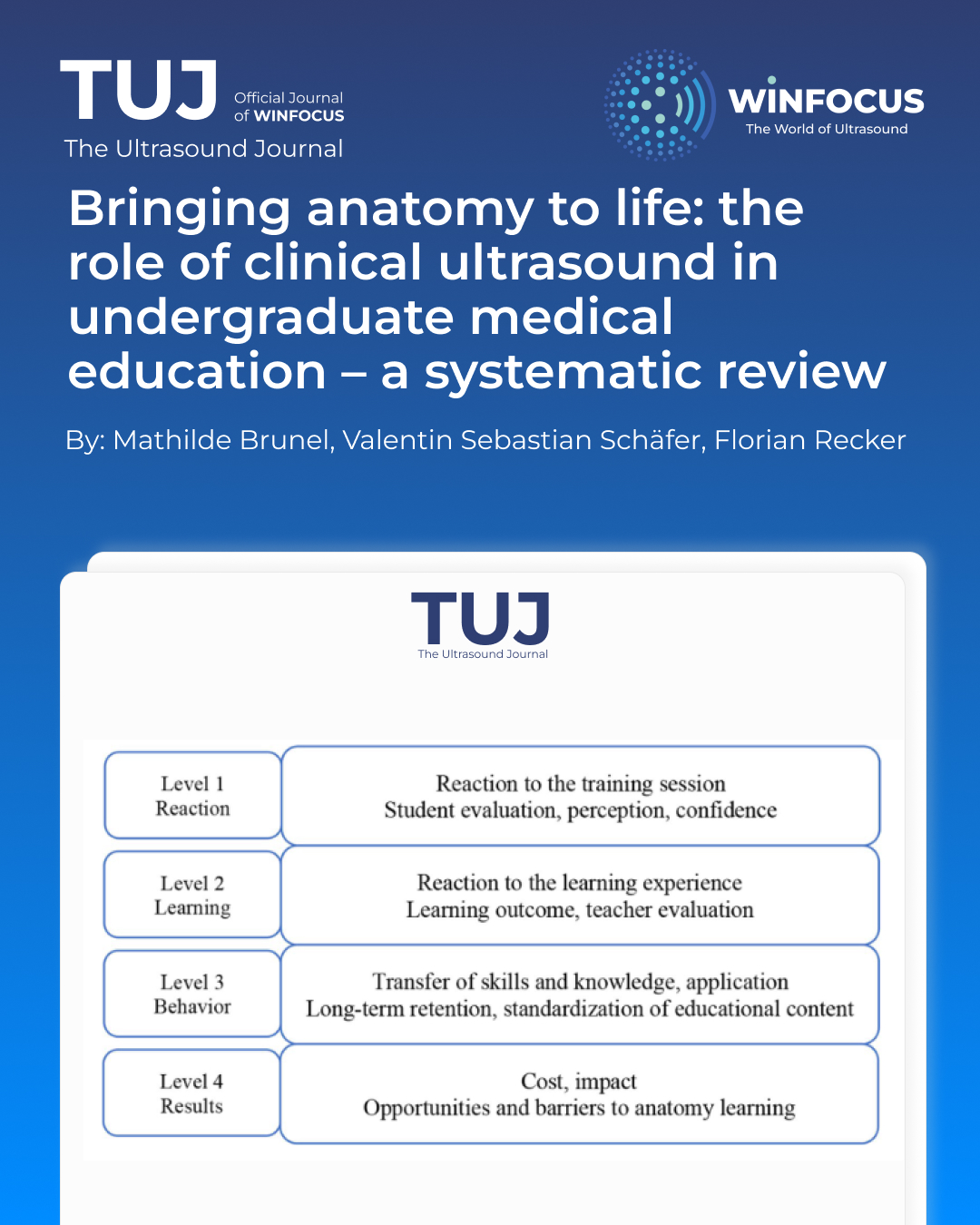
14. Kirkpatrick DL, Kirkpatrick JD (2006) Evaluating training programs: the four levels, 3rd edn. Berrett-Koehler, San Francisco, CA
15. Page MJ, McKenzie JE, Bossuyt PM, Boutron I, Hoffmann TC, Mulrow CD et al (2021) The PRISMA 2020 statement: an updated guideline for reporting systematic reviews. BMJ 372:n71. https://doi.org/10.1136/bmj.n71
16. Methley AM, Campbell S, Chew-Graham C, McNally R, Cheraghi-Sohi S (2014) PICO, PICOS and SPIDER: a comparison study of specificity and sensitivity in three search tools for qualitative systematic reviews. BMC Health Serv Res 14. https://doi.org/10.1186/s12913-014-0579-0
17. Beckman TJ, Cook DA, Mandrekar JN (2005) What is the validity evidence for assessments of clinical teaching? J Gen Intern Med 20:1159–1164. https://doi.org/10.1111/j.1525-1497.2005.0258.x
18. Neubauer R, Bauer CJ, Dietrich CF, Strizek B, Schäfer VS, Recker F (2024) Evidence-based ultrasound education? – A systematic literature review of undergraduate ultrasound training studies. Ultrasound Int Open 10:a22750702. https://doi.org/10.1055/a-2275-0702
19. Singer AD, Younan Y, Saadat V, Umpierrez M, Kesner V, Boulis N et al (2020) Performance of an interactive upper extremity peripheral nerve training module among medical students, radiology residents, and fellows: a multi-institutional study. Curr Probl Diagn Radiol 49:7–11. https://doi.org/10.1067/j.cpradiol.2018.12.011
20. Patten D (2014) Using ultrasound to teach anatomy in the undergraduate medical curriculum: an evaluation of the experiences of tutors and medical students. Ultrasound 23:18–28. https://doi.org/10.1177/1742271X14542173
21. Kefala-Karli P, Sassis L, Sassi M, Zervides C (2021) Introduction of ultrasound-based living anatomy into the medical curriculum: a survey on medical students’ perceptions. Ultrasound J 13. https://doi.org/10.1186/s13089-021-00247-1
22. Pazeli JM, Vieira ALS, Vicentino RS, Pazeli LJ, Lemos BC, Saliba MMR et al (2018) Point-of-care ultrasound evaluation and puncture simulation of the internal jugular vein by medical students. Crit Ultrasound J 10. https://doi.org/10.1186/s13089-018-0115-2
23. Zeitouni F, Matejka C, Boomer M, Lee VH, Brower GL, Hewetson A et al (2024) Integration of point of care ultrasound into undergraduate medical education at Texas tech university health sciences center school of medicine: a 6 year review. BMC Med Educ 24. https://doi.org/10.1186/s12909-024-06483-y
24. Carter JL, Patel A, Hocum G, Benninger B (2017) Thyroid gland visualization with 3D/4D ultrasound: integrated hands-on imaging in anatomical dissection laboratory. Surg Radiol Anat 39:567–572. https://doi.org/10.1007/s00276-016-1775-x
25. Davis JJ, Wessner CE, Potts J, Au AK, Pohl CA, Fields JM (2018) Ultrasonography in undergraduate medical education: A systematic review. J Ultrasound Med 37:2667–2679. https://doi.org/10.1002/jum.14628
26. Umar MS, Zira JD, Ogenyi PA, Njokwu G, Malgwi FD, Silas MA, Laushongo SS (2019) Real time sonography as an anatomy teaching aid in undergraduate radiography institutions in Northern Nigeria. Afri Health Sci 19:2282–2289. https://doi.org/10.4314/ahs.v19i2.54
27. Chang Chan AYC, Mejía BLL, Chavarría REM, Osmany SN, Robles ADM (2022) Radiological anatomy as an alternative approach in anatomy teaching. Perception and performance of medical students. Inv Ed Med 11:26–34. https://doi.org/10.22201/fm.20075057e.2022.41.21384
28. Webb EM, Cotton JB, Kane K, Straus CM, Topp KS, Naeger DM (2014) Teaching point of care ultrasound skills in medical school: keeping radiology in the driver’s seat. Acad Radiol 21:893–901. https://doi.org/10.1016/j.acra.2014.03.001
29. Prager R, McCallum J, Kim D, Neitzel A (2016) Point of care ultrasound in undergraduate medical education: a survey of university of British Columbia medical student attitudes. UBC Med J 7:12–16
30. Nausheen F, Young C, Brazil J, Dunagan T, Bhupathy R, Elango S, Crowley J (2020) Confidence level and ability of medical students to identify abdominal structures after integrated ultrasound sessions. Ultrasound Int Open 6:7–13. https://doi.org/10.1055/a-1199-1578
31. Shah VS, Allman A, Verbeck N, Quinn M, Prats MI (2021) Ultrasound’s impact on preclinical medical student neurology unit grades: findings after 2 years. J Ultrasound Med 40:1903–1910. https://doi.org/10.1002/jum.15573
32. de Vries KD, Brown R, Mazzie J, Jung MK, Yao SC, Terzella MJ (2018) Effect of ultrasonography on student learning of shoulder anatomy and landmarks. J Am Osteopath Assoc 118:34–39. https://doi.org/10.7556/jaoa.2018.006
33. Haji-Hassan M, Călinici T, Drugan T, Bolboacă SD (2022) Effectiveness of ultrasound cardiovascular images in teaching anatomy: a pilot study of an eight-hour training exposure. Int J Environ Res Public Health 19:3033. https://doi.org/10.3390/ijerph19053033
34. Situ-LaCasse EH, Amini R, Bain V, Acuña J, Samsel K, Weaver C et al (2019) Performance of ultrasound-guided peripheral nerve blocks by medical students after one-day training session. Cureus 11:e3911. https://doi.org/10.7759/cureus.3911
35. Shah VS, Cavalcanti M, Scheetz S, Bahner DP, Dornbos DL III, Prats MI (2020) Teaching neurological disorders with ultrasound: a novel workshop for medical students. Brain Circ 6:38–46. https://doi.org/10.4103/bc.bc_30_19
36. Weaver C, Heath DM, Makin IRS, Hanamaika’i K, Kanumalla R, Matsushita S et al (2023) Effects of a focused training on first-year osteopathic medical students’ ability to incorporate point-of-care ultrasound in assessment of the anterior knee. J Osteopath Med 123:475–484. https://doi.org/10.1515/jom-2022-0186
37. Cohen K, Kidd J, Schiller E, Kantorowska A, Kinzler W, Chavez M (2023) Obstetric-focused POCUS training for medical students. POCUS J 8:109–112. https://doi.org/10.24908/pocus.v8i2.16316
38. Khoury M, Fotsing S, Jalali A, Chagnon N, Malherbe S, Youssef N (2020) Preclerkship point-of-care ultrasound: image acquisition and clinical transferability. J Med Educ Curric Dev 7. https://doi.org/10.1177/2382120520943615
39. Steinmetz P, Oleskevich S, Lewis J (2016) Acquisition and long-term retention of bedside ultrasound skills in first-year medical students. J Ultrasound Med 35:1967–1975. https://doi.org/10.7863/ultra.15.09088
40. Cecilio-Fernandes D, Cnossen F, Coster J, Jaarsma A, Debbie) C, Tio RA (2020) The effects of expert and augmented feedback on learning a complex medical skill. Percept Mot Ski 127:766–784. https://doi.org/10.1177/0031512520914680
41. Kondrashova T, Kondrashov P (2018) Integration of ultrasonography into the undergraduate medical curriculum: seven years of experience. Mo Med 115:38–43
42. Russell FM, Herbert A, Ferre RM, Zakeri B, Echeverria V, Peterson D, Wallach P (2021) Development and implementation of a point of care ultrasound curriculum at a multi-site institution. Ultrasound J 13. https://doi.org/10.1186/s13089-021-00214-w
43. Boivin Z, Carpenter S, Lee G, Chimileski B, Harrison J, Choudhary D, Herbst M (2022) Evaluation of a required vertical point-of-care ultrasound curriculum for undergraduate medical students. Cureus 14:e30002. https://doi.org/10.7759/cureus.30002
44. Hey MT, Masimbi O, Shimelash N, Alayande BT, Forbes C, Twizeyimana J et al (2023) Simulation-based breast biopsy training using a low-cost gelatin-based breast model in Rwanda. World J Surg 47:2169–2177. https://doi.org/10.1007/s00268-023-07038-w
45. Bauman B, Kernahan P, Weinhaus A, Walker MJ, Irwin E, Sundin A, Yerxa D, Vakayil V, Harmon JV (2021) An interprofessional senior medical student Preparation course: improvement in knowledge and self-confidence before entering surgical training. Adv Med Educ Pract 12:441–451. https://doi.org/10.2147/AMEP.S287430
46. Miner B, Purdy A, Curtis L, Simonson K, Shumway C, Baker J et al (2015) Feasibility study of first-year medical students identifying cardiac anatomy using ultrasound in rural Panama. World J Emerg Med 6:191–195. https://doi.org/10.5847/wjem.j.1920-8642.2015.03.005
47. Nithipalan V, Holler T, Schuler N, Shepard L, Ghazi A (2024) Evaluation of mixed reality technologies for remote feedback and guidance during transrectal ultrasound biopsy simulation: a prospective, randomized, crossover study. Urology 183:25–31. https://doi.org/10.1016/j.urology.2023.10.029
48. Nausheen F, Scali F, Hassan SS (2021) Impact of multimodality integrated anatomy teaching approach towards teaching effectiveness, student engagement, and social interaction. Eur J Anat 25:93–101
49. McKinley H, Stuart H, Ailawadi S, Brunswick J (2023) Utilizing 3-dimensional cardiac models with point-of-care ultrasound video tutorials to improve medical student education: a double-blinded randomized control study. Cureus 15:e34978. https://doi.org/10.7759/cureus.34978
50. Darici D, Missler M, Schober A, Masthoff M, Schnittler H, Schmitz M (2022) Fun slipping into the doctor’s role—The relationship between sonoanatomy teaching and professional identity formation before and during the Covid-19 pandemic. Anat Sci Educ 15:447–463. https://doi.org/10.1002/ase.2178
51. Kochhar S, Tasnim T, Gupta A (2023) Is cadaveric dissection essential in medical education? A qualitative survey comparing pre-and post-COVID-19 anatomy courses. J Osteopath Med 123:19–26. https://doi.org/10.1515/jom-2022-0016
52. Meuwly JY, Mandralis K, Tenisch E, Gullo G, Frossard P, Morend L (2021) Use of an online ultrasound simulator to teach basic psychomotor skills to medical students during the initial COVID-19 lockdown: quality control study. JMIR Med Educ 7:e31132. https://doi.org/10.2196/31132
53. Michaelis A, Weidenbach M, Altmann I, Markel F, Löffelbein F, Dähnert I et al (2025) Looking through the crystal ball feasibility of tele-echocardiography using smart glasses in neonates: a pilot study. Cardiol Young 35:87–92. https://doi.org/10.1017/S1047951124026647
Downloads
Published
Issue
Section
License
Copyright (c) 2025 Mathilde Brunel, Valentin Sebastian Schäfer, Florian Recker (Author)

This work is licensed under a Creative Commons Attribution-NonCommercial 4.0 International License.
This is an Open Access article distributed under the terms of the Creative Commons Attribution License (https://creativecommons.org/licenses/by-nc/4.0) which permits unrestricted use, distribution, and reproduction in any medium, provided the original work is properly cited.
Authors retain the copyright for their published work. No formal permission will be required to reproduce parts (tables or illustrations) of published papers, provided the source is quoted appropriately and reproduction has no commercial intent.
How to Cite