Diagnostic accuracy of ultrasound in assessing medial collateral ligament and medial meniscus injuries? A systematic review and meta-analysis.
Keywords:
Medial Collateral Ligament, Medial Meniscus, Knee Injuries, Ultrasound, Magnetic resonance imagingAbstract
Background: Medial Collateral Ligament (MCL) and Medial Meniscus (MM) injuries are common medial knee pathologies. While MRI and arthroscopy are gold-standard diagnostic modalities, they are costly, invasive, and often delayed. Ultrasound is fast, inexpensive, and non-invasive, with growing use clinically, particularly point-of-care ultrasound (POCUS). This systematic review and meta-analysis aims were to evaluate ultrasound’s diagnostic performance for MCL and MM injuries, both as standalone modalities and initial screening tools.
Methods: A systematic search of PubMed, Cochrane, Embase, CINAHL, and Google Scholar identified studies between 1st October 2014 and 31st October 2024. Fourteen studies (1,259 patients) met inclusion criteria. Methodological quality was assessed using validated tools.
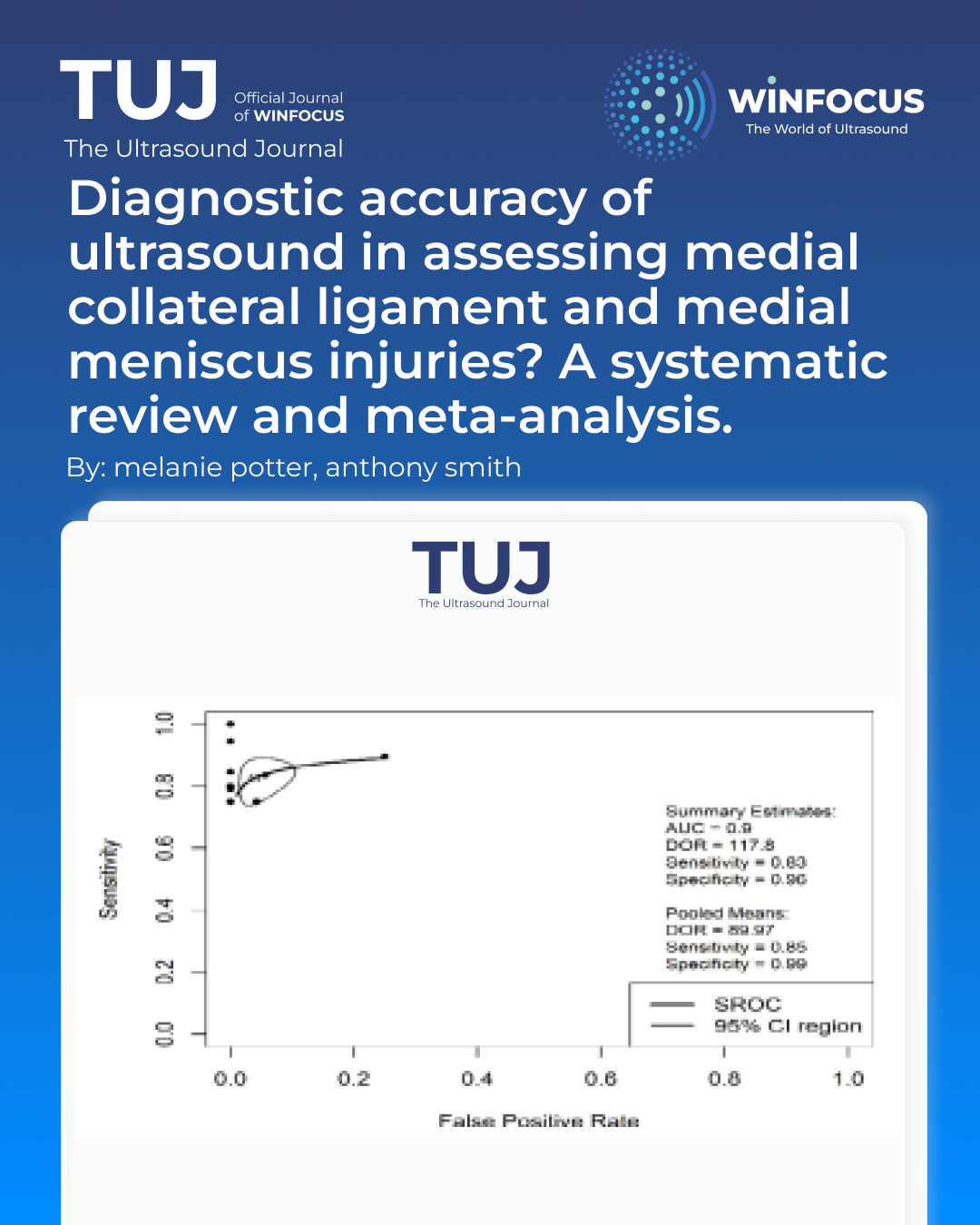
Results: Overall risk of bias was low, with moderate certainty of evidence for MCL and low certainty for MM injuries. Nine studies (713 patients) evaluated MCL injuries. Bivariate meta-analysis showed pooled sensitivity 0.83 (95% CI: 0.76–0.88), specificity 0.96 (95% CI: 0.91–0.98), diagnostic odds ratio (DOR) 117.8, and area under the SROC curve (AUC) 0.90. Heterogeneity was minimal (I² = 0%). Twelve studies (969 patients) evaluated MM injuries, with pooled sensitivity 0.85 (95% CI: 0.82–0.88), specificity 0.89 (95% CI: 0.81–0.94), DOR 45, and AUC 0.88. Heterogeneity was low for sensitivity but substantial for specificity (I² = 70.6%).
Conclusions: Ultrasound demonstrated high specificity for MCL and moderate sensitivity for MM injuries. It may serve as a valuable modality for MCL injuries in POCUS settings and as an initial screening tool for MM injuries. As POCUS utilisation expands, it may support diagnostic pathways.
References
1. Meyer P, Reiter A, Akoto R, Steadman J, Pagenstert G, Frosch KH, et al. Imaging of the medial collateral ligament of the knee: a systematic review. Arch Orthop Trauma Surg. 2022;142(12):3721–36. https://doi.org/10.1007/s00402-021-04200-8.
2. Memarzadeh A, Melton JT. Medial collateral ligament of the knee: anatomy, management and surgical techniques for reconstruction. Orthop Trauma. 2019;33(2):91–9. https://doi.org/10.1016/j.mporth.2019.01.004.
3. Luvsannyam E, Jain MS, Leitao AR, Maikawa N, Leitao AE. Meniscus Tear: Pathology, Incidence, and Management. Cureus. 2022;14(5):e25121. https://doi.org/10.7759/cureus.25121.
4. Braaten JA, Banovetz MT, Rodriguez AN, Thomas P, LaPrade RF. From Anatomy to Complex Reconstruction: A Modern Review on the Medial Collateral Ligament of the Knee. Arch Bone Jt Surg. 2022;10(10):818–26. https://doi.org/10.22038/ABJS.2022.66697.3179.
5. Andrews K, Lu A, McKean L, Ebraheim N. Review: Medial collateral ligament injuries. J Orthop. 2017;14(4):550–4. https://doi.org/10.1016/j.jor.2017.07.017.
6. Encinas-Ullan CA, Rodriguez-Merchan EC. Isolated medial collateral ligament tears: An update on management. EFORT Open Rev. 2018;3(7):398–407. https://doi.org/10.1302/2058-5241.3.170035.
7. Vosoughi F, Rezaei Dogahe R, Nuri A, Ayati Firoozabadi M, Mortazavi J. Medial Collateral Ligament Injury of the Knee: A Review on Current Concept and Management. Arch Bone Jt Surg. 2021;9(3):255–62. https://doi.org/10.22038/abjs.2021.48458.2401.
8. Gelber PE, Perelli S. Treatment of the medial collateral ligament injuries. Ann Jt. 2018;3:78–89.
9. Kopf S, Beaufils P, Hirschmann MT, Rotigliano N, Ollivier M, Pereira H, et al. Management of traumatic meniscus tears: the 2019 ESSKA meniscus consensus. Knee Surg Sports Traumatol Arthrosc. 2020;28(4):1177–94. https://doi.org/10.1007/s00167-020-05847-3.
10. Jarraya M, Roemer FW, Englund M, Crema MD, Gale HI, Hayashi D, et al. Meniscus morphology: does tear type matter? A narrative review with focus on relevance for osteoarthritis research. Semin Arthritis Rheum. 2017;46(5):552–61. https://doi.org/10.1016/j.semarthrit.2016.11.005.
11. Ozeki N, Koga H, Sekiya I. Degenerative Meniscus in Knee Osteoarthritis: From Pathology to Treatment. Life (Basel). 2022;12(4):603. https://doi.org/10.3390/life12040603.
12. D'Agostino V, Sorriento A, Cafarelli A, Donati D, Papalexis N, Russo A, et al. Ultrasound Imaging in Knee Osteoarthritis: Current Role, Recent Advancements, and Future Perspectives. J Clin Med. 2024;13(16):4930. https://doi.org/10.3390/jcm13164930.
13. NHS England. NHS diagnostic waiting times and activity data: NHS; 2024 [12 September 2024]. Available from: https://www.england.nhs.uk.
14. Kings Fund. Why do Diagnostics matter? Maximising the potential of diagnostics services. October 2022 [12 September 2024]. Available from: http://www.kingsfund.org.uk/publications/why-do-diagnostics-matter.
15. Turner AJ, Francetic I, Watkinson R, Gillibrand S, Sutton M. Socioeconomic inequality in access to timely and appropriate care in emergency departments. J Health Econ. 2022;85:102668. https://doi.org/10.1016/j.jhealeco.2022.102668.
16. DeBenedectis CM, Spalluto LB, Americo L, Bishop C, Mian A, Sarkany D, et al. Health Care Disparities in Radiology-A Review of the Current Literature. J Am Coll Radiol. 2022;19(1 Pt B):101–11. https://doi.org/10.1016/j.jacr.2021.08.024.
17. Fraleigh CDM, Duff E. Point-of-care ultrasound: An emerging clinical tool to enhance physical assessment. Nurse Pract. 2022;47(8):14–20. https://doi.org/10.1097/01.NPR.0000841944.00536.b2.
18. Dai H, Huang ZG, Chen ZJ, Liu JX. Diagnostic accuracy of ultrasonography in assessing meniscal injury: meta-analysis of prospective studies. J Orthop Sci. 2015;20(4):675–81. https://doi.org/10.1007/s00776-015-0728-2.
19. Xia XP, Chen HL, Zhou B. Ultrasonography for meniscal injuries in knee joint: a systematic review and meta-analysis. J Sports Med Phys Fitness. 2016;56(10):1179–87.
20. Dong F, Zhang L, Wang S, Dong D, Xu J, Wu H, et al. The diagnostic accuracy of B-mode ultrasound in detecting meniscal tears: a systematic review and pooled meta-analysis. Med Ultrason. 2018;20(2):164–9. https://doi.org/10.11152/mu-1252.
21. Smith GD, Ho KH. Systematic reviews: When should they be updated? J Clin Nurs. 2023;32(9-10):e17–e8. https://doi.org/10.1111/jocn.16547.
22. Gusenbauer M, Haddaway NR. Which academic search systems are suitable for systematic reviews or meta-analyses? Evaluating retrieval qualities of Google Scholar, PubMed, and 26 other resources. Res Synth Methods. 2020;11(2):181–217. https://doi.org/10.1002/jrsm.1378.
23. Pati D, Lorusso LN. How to Write a Systematic Review of the Literature. HERD. 2018;11(1):15–30. https://doi.org/10.1177/1937586717747384.
24. Lefebvre C, Glanville J, Briscoe S, et al. Searching for and selecting studies. In Cochrane Handbook for Systematic Reviews. Cochrane; 2023. Chapter 4. https://training.cochrane.org/handbook/current/chapter-04.
25. Bramer WM, Rethlefsen ML, Kleijnen J, Franco OH. Optimal database combinations for literature searches in systematic reviews: a prospective exploratory study. Syst Rev. 2017;6(1):245. https://doi.org/10.1186/s13643-017-0644-y.
26. Goossen K, Hess S, Lunny C, Pieper D. Database combinations to retrieve systematic reviews in overviews of reviews: a methodological study. BMC Med Res Methodol. 2020;20(1):138. https://doi.org/10.1186/s12874-020-00983-3.
27. Arber M, Glanville J, Isojarvi J, Baragula E, Edwards M, Shaw A, et al. Which Databases Should Be Used to Identify Studies for Systematic Reviews of Economic Evaluations? Int J Technol Assess Health Care. 2018;34(6):547–54. https://doi/org/10.1017/S0266462318000636.
28. Bramer WM, de Jonge GB, Rethlefsen ML, Mast F, Kleijnen J. A systematic approach to searching: an efficient and complete method to develop literature searches. J Med Libr Assoc. 2018;106(4):531–41. https://doi.org/10.5195/jmla.2018.283.
29. Leeflang MM. Systematic reviews and meta-analyses of diagnostic test accuracy. Clin Microbiol Infect. 2014;20(2):105–13. https://doi.org/10.1111/1469-0691.12474.
30. Xu C, Ju K, Syed A, Lin L, Jia P, Kwong JSW, et al. Rapid evidence synthesis approach for limits on the search date: How rapid could it be? J Res Synth Methods. 2021;12(6):738–754. https://doi.org/10.1002/jrsm.1525.
31. Strike K, Chan AKC, Maly MR, Newman ANL, Solomon P. Physiotherapist performed Point of Care Ultrasonography (POCUS): a scoping review of 209 studies. Physiotherapy. 2023;119:34–43. https://doi.org/10.1016/j.physio.2022.11.005.
32. Paez A. Gray literature: An important resource in systematic reviews. J Evid Based Med. 2017;10(3):233–40. https://doi.org/10.1111/jebm.12266.
33. Rethlefsen ML, Kirtley S, Waffenschmidt S, Ayala AP, Moher D, Page MJ, et al. PRISMA-S: an extension to the PRISMA Statement for Reporting Literature Searches in Systematic Reviews. Syst Rev. 2021;10(1):39. https://doi: 10.1186/s13643-020-01542-z.
34. Yang B, Mallett S, Takwoingi Y, Davenport CF, Hyde CJ, Whiting PF, et al. QUADAS-C: A Tool for Assessing Risk of Bias in Comparative Diagnostic Accuracy Studies. Ann Intern Med. 2021;174(11):1592–9. https://doi.org/10.7326/M21-2234.
35. Dinnes KSG, Jones HE, Hyde CJ, Lange S, Langendam MW, Leeflang MM, et al. Guidance on how to use QUADAS-C 2021 [17 November 2024]. Available from: https://www.bristol.ac.uk/media-library/sites/social-community-medicine/quadas/Guidance%20on%20how%20to%20use%20QUADAS-C.pdf.
36. Balshem H, Helfand M, Schunemann HJ, Oxman AD, Kunz R, Brozek J, et al. GRADE guidelines: 3. Rating the quality of evidence. J Clin Epidemiol. 2011;64(4):401–6. https://doi.org/10.1016/j.jclinepi.2010.07.015.
37. Guyatt G, Oxman AD, Akl EA, Kunz R, Vist G, Brozek J, et al. GRADE guidelines: 1. Introduction-GRADE evidence profiles and summary of findings tables. J Clin Epidemiol. 2011;64(4):383–94. https://doi.org/10.1016/j.jclinepi.2010.04.026.
38. Granholm A, Alhazzani W, Moller MH. Use of the GRADE approach in systematic reviews and guidelines. Br J Anaesth. 2019;123(5):554–9. https://doi.org/10.1016/j.bja.2019.08.015.
39. Al Duhailib Z, Granholm A, Alhazzani W, Oczkowski S, Belley-Cote E, Moller MH. GRADE pearls and pitfalls-Part 1: Systematic reviews and meta-analyses. Acta Anaesthesiol Scand. 2024;68(5):584–92. https://doi.org/10.1111/aas.14386.
40. Shim SR, Kim SJ, Lee J. Diagnostic test accuracy: application and practice using R software. Epidemiol Health. 2019;41:e2019007. https://doi.org/10.4178/epih.e2019007.
41. Reitsma JB, Glas AS, Rutjes AW, Scholten RJ, Bossuyt PM, Zwinderman AH. Bivariate analysis of sensitivity and specificity produces informative summary measures in diagnostic reviews. J Clin Epidemiol. 2005;58(10):982–90. https://doi.org/10.1016/j.jclinepi.2005.02.022.
42. Ahmadi O, Heydari F, Golshani K, Derakhshan S. Point-Of-Care Ultrasonography for Diagnosis of Medial Collateral Ligament Tears in Acute Knee Trauma; a Diagnostic Accuracy Study. Arch Acad Emerg Med. 2022;10(1):e47. https://doi.org/10.22037/aaem.v10i1.1480.
43. Ahmadi O, Motififard M, Heydari F, Golshani K, Azimi Meibody A, Hatami S. Role of point-of-care ultrasonography (POCUS) in the diagnosing of acute medial meniscus injury of knee joint. Ultrasound J. 2022;14(1):7. https://doi.org/10.1186/s13089-021-00256-0.
44. Ahmadi O, Motififard M, Heydari F, Hatami S, Meibody AA. The predictive value of point-of-care ultrasonography versus magnetic resonance imaging in assessing medial meniscal tears in patients with acute knee injury. Clin Exp Emerg Med. 2024;11(2):188–94. https://doi.org/10.15441/ceem.23.111.
45. Singh AP, Chandak S, Agarwal A, Malhotra A, Jain A, Khan AA. Utility of high-resolution sonography for evaluation of knee joint pathologies as a screening tool. JDMS. 2021;37(6):556–67. https://doi.org/10.1177/87564793211035773.
46. Muresan S, Muresan M, Voidazan S, Neagoe R. The accuracy of musculoskeletal ultrasound examination for the exploration of meniscus injuries in athletes. J Sports Med Phys Fitness. 2017;57(5):589–94. https://doi.org/10.23736/S0022-4707.17.06132-1.
47. Singh A, Mangat I, Thukral C, Gupta K. Diagnostic accuracy of ultrasonography in evaluation of knee injuries with magnetic resonance imaging correlation. Int J Anat Radiol Surg. 2018;7(1):50–5.
48. Elshimy A, Osman AM, Awad MES, Abdel Aziz MM. Diagnostic accuracy of point-of-care knee ultrasound for evaluation of meniscus and collateral ligaments pathology in comparison with MRI. Acta Radiol. 2023;64(7):2283–92. https://doi.org/10.1177/02841851211058280.
49. Mohanan G, Chandan K, Unnikrishnan J, Job S. Relevance of Sonological Evaluation in Medial Knee Injuries and Its Comparison with Magnetic Resonance Imaging Findings–A Prospective Study. J Orthop Trauma. 2023;6(1):7–12. https://doi.org/10.4103/jodp.jodp_23_22.
50. Khalaf AS, El-Sherif AM, Mohamed MF, Zein AM. Role of Ultrasonography in Evaluation of Abnormalities of Menisco Collateral Complex of The Knee joint; A Comparative Study with Magnetic resonance imaging, Arthroscopy and Clinical findings. MJMR. 2020;31(1):169–79.
51. Hussain S, Fahmy M, Ali KAM. Role of ultrasound in assessment of menisco-ligamentous injuries of knee joint in comparison with magnetic resonance imaging. Med J Cairo Univ. 2019;87(December):4571–7.
52. Reda Abdullah Ali M, Abdul Fatah Mahmoud Abo-Rashed A, Muhammad Moustafa A. Role of Ultrasound in the Evaluation of Painful Knee. A Comparative Study to MRI. Al Azhar Med J. 2021;50(3):2351–62. https://doi.org/10.21608/amj.2021.179483.
53. Elkholy EE-EA-E, Ashour AYA, Awad-Allah A-AA, Mahmoud AMZ. The Role of High-Resolution Ultrasound in Evaluation of knee Meniscal Lesions: A Comparative Study to Magnetic Resonance Imaging. Int J Med Arts. 2022;4(6):2463–70. https://doi.org/10.21608/ijma.2022.141336.1459.
54. Mir F, Raina Z, Shah O, Gojwari T, Robbani I, Shera T. Menisco-ligamentous injuries of knee joint: Can ultrasonography serve as an effective screening modality? Healthc low-resource settings. 2021;9(1). https://doi.org/10.4081/hls.2021.9731.
55. Awan F, Mondal P, van der Merwe JM, Vassos N, Obaid H. The Utility of a Community-Based Knee Ultrasound in Detecting Meniscal Tears: A Retrospective Analysis in Comparison with MRI. Healthcare. 2024;12(20):2051. https://doi.org/10.3390/healthcare12202051.
56. Alizadeh A, Babaei Jandaghi A, Keshavarz Zirak A, Karimi A, Mardani-Kivi M, Rajabzadeh A. Knee sonography as a diagnostic test for medial meniscal tears in young patients. Eur J Orthop Surg Traumatol. 2013;23(8):927–31. https://doi.org/10.1007/s00590-012-1111-z.
57. Anatolia AM. The role of ultrasound in the diagnosis of meniscal tears and degeneration compared to MRI and arthroscopy. Acta Med Anatol. 2014;2(3):80–7.
58. Shepard MF, Hunter DM, Davies MR, Shapiro MS, Seeger LL. The clinical significance of anterior horn meniscal tears diagnosed on magnetic resonance images. Am J Sports Med. 2002;30(2):189–92. https://doi.org/10.1177/03635465020300020701.
59. Smith I, Julious P, Barrett GR. Medial and lateral meniscal tear patterns in anterior cruciate ligament-deficient knees: a prospective analysis of 575 tears. The American journal of sports medicine. 2001;29(4):415–9. https://doi.org/10.1177/03635465010290040501.
60. Rodriguez-Sanz J, Malo-Urries M, Borrella-Andres S, Albarova-Corral I, Lopez-de-Celis C. Validation of Ultrasound for Quantification of Knee Meniscal Tissue: A Cadaveric Study. Diagnostics (Basel). 2025;15(3):389. https://doi.org/10.3390/diagnostics15030389.
61. Akatsu Y, Yamaguchi S, Mukoyama S, Morikawa T, Yamaguchi T, Tsuchiya K, et al. Accuracy of high-resolution ultrasound in the detection of meniscal tears and determination of the visible area of menisci. J Bone Joint Surg Am. 2015;97(10):799–806. https://doi.org/10.2106/JBJS.N.01055.
62. Carr JC, Gerstner GR, Voskuil CC, Harden JE, Dunnick D, Badillo KM, et al. The Influence of Sonographer Experience on Skeletal Muscle Image Acquisition and Analysis. J Funct Morphol Kinesiol. 2021;6(4):91. https://doi.org/10.3390/jfmk6040091.
63. Stolz LA, Stolz U, Fields JM, Saul T, Secko M, Flannigan MJ, et al. Emergency Medicine Resident Assessment of the Emergency Ultrasound Milestones and Current Training Recommendations. Acad Emerg Med. 2017;24(3):353–61. https://doi.org/10.1111/acem.13113.
64. Kim DM, Seo JS, Jeon IH, Cho C, Koh KH. Detection of Rotator Cuff Tears by Ultrasound: How Many Scans Do Novices Need to Be Competent? Clin Orthop Surg. 2021;13(4):513–9. https://doi.org/10.4055/cios20259.
Downloads
Additional Files
Published
Issue
Section
License
Copyright (c) 2026 Melanie Potter, Anthony Smith (Author)

This work is licensed under a Creative Commons Attribution-NonCommercial 4.0 International License.
This is an Open Access article distributed under the terms of the Creative Commons Attribution License (https://creativecommons.org/licenses/by-nc/4.0) which permits unrestricted use, distribution, and reproduction in any medium, provided the original work is properly cited.
Authors retain the copyright for their published work. No formal permission will be required to reproduce parts (tables or illustrations) of published papers, provided the source is quoted appropriately and reproduction has no commercial intent.
How to Cite