Effectiveness of obstetric point-of-care ultrasound (POCUS) training: a systematic review and meta-analysis based on the ADDIE training model
Keywords:
Point-of-care systems, Ultrasonography, Prenatal, Education, Medical, Developing countries, Systematic reviewAbstract
Aim: To identify the core components of obstetric point-of-care ultrasound (POCUS) training programs while simultaneously evaluating the effectiveness of these programs using the Analyze, Design, Develop, Implement, and Evaluate (ADDIE) model.
Methods: This systematic review and meta-analysis followed a PROSPERO-registered protocol (CRD42024566260) and adhered to PRISMA2020, Cochrane Handbook, and JBI Manual guidelines. Comprehensive searches from database inception to September 22, 2024, covered international and Chinese databases to identify studies evaluating obstetric POCUS training. Two independent reviewers screened studies, assessed methodological quality with JBI tools, and extracted data on study, participant, intervention, and outcome characteristics. Training content was mapped to the ADDIE instructional design model via thematic and framework analyses. Meta-analyses of comparable quantitative outcomes used random-effects models. Integrating quantitative and qualitative findings, this review systematically evaluated the effectiveness and implementation of obstetric POCUS training programs.
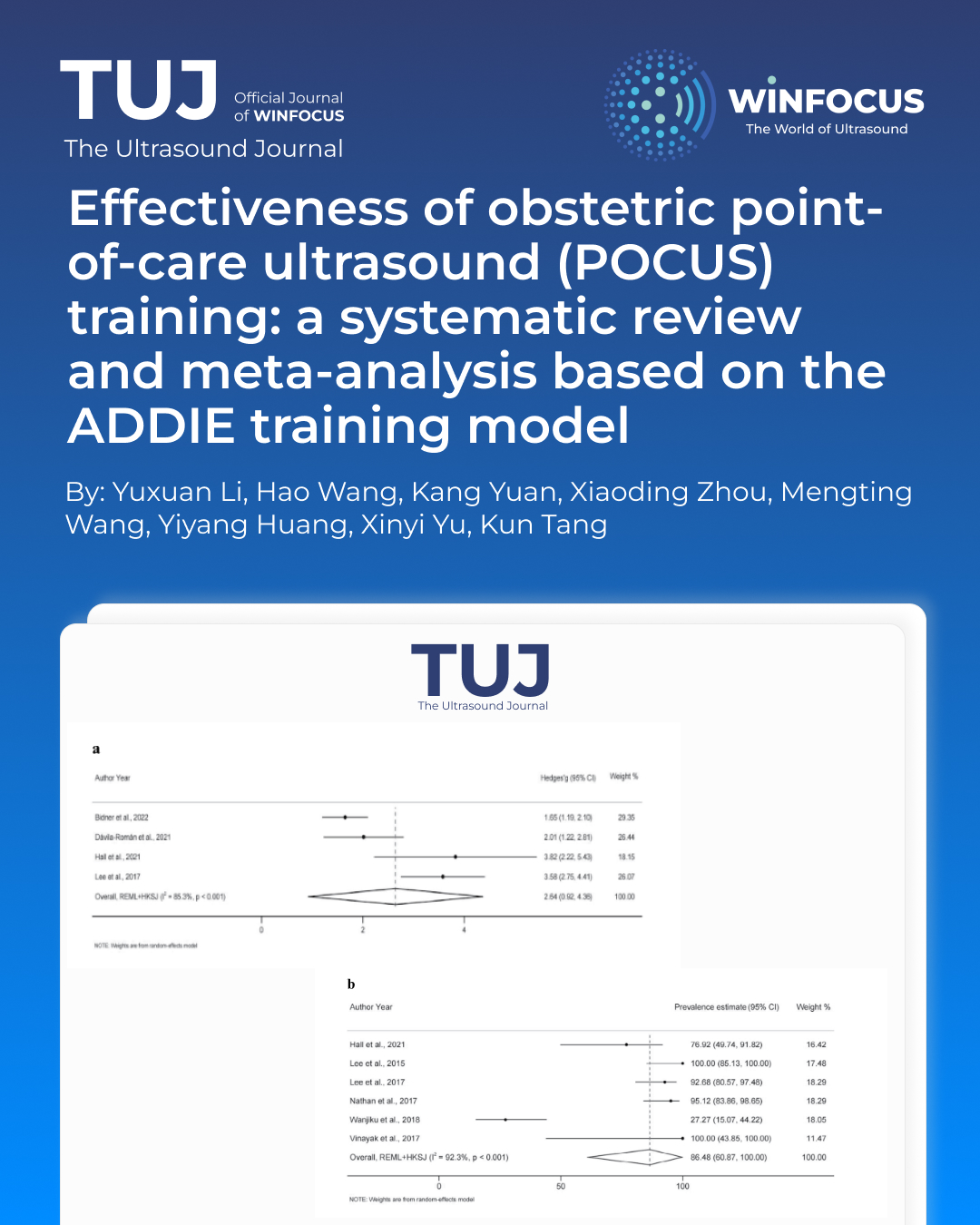
Results: Systematic synthesis showed that obstetric POCUS training significantly improved healthcare providers’ competencies, including knowledge, skills, sustained use, and clinical decision-making. Training also increased antenatal care attendance and identification of high-risk pregnancies, while reducing referrals and optimizing resource use. However, limitations were noted in needs assessment, implementation flexibility, and outcome evaluation. Using thematic and framework analyses combined with the ADDIE model, we systematically organized training phases and key components to provide a scientific basis for program improvement and optimization.
Conclusions: Obstetric POCUS training effectively enhances clinical competencies and improves maternal and neonatal health outcomes. Applying the ADDIE model offers a replicable, practical, and sustainable approach for developing standardized training programs. Future obstetric POCUS training should leverage the ADDIE model and adapt to local contexts to improve maternal and neonatal health globally.
References
1. Parulekar P, Harris T, Jarman R (2019) The use of lung ultrasound in acute medicine. Acute Med J 18:239–246. https://doi.org/10.52964/AMJA.0783
2. Recker F, Weber E, Strizek B, Gembruch U, Westerway SC, Dietrich CF (2021) Point-of-care ultrasound in obstetrics and gynecology. Arch Gynecol Obstet 303:871–876. https://doi.org/10.1007/s00404-021-05972-5
3. Shah S, Santos N, Kisa R, Maxwell OM, Mulowooza J, Walker D et al (2020) Efficacy of an ultrasound training program for nurse midwives to assess high-risk conditions at labor triage in rural Uganda. PLoS ONE 15:e0235269. https://doi.org/10.1371/journal.pone.0235269
4. Shokoohi H, Raymond A, Fleming K, Scott J, Kerry V, Haile-Mariam T et al (2019) Assessment of point-of-care ultrasound training for clinical educators in Malawi, Tanzania and Uganda. Ultrasound Med Biol 45:1351–1357. https://doi.org/10.1016/j.ultrasmedbio.2019.01.019
5. World Health Organization, UNICEF, UNFPA, World Bank Group, UNDESA (2025) Trends in maternal mortality estimates 2000–2023. World Health Organization, Geneva
6. Toscano M, Marini TJ, Drennan K, Baran TM, Kan J, Garra B et al (2021) Testing telediagnostic obstetric ultrasound in Peru: a new horizon in expanding access to prenatal ultrasound. BMC Pregnancy Childbirth 21:1–13. https://doi.org/10.1186/s12884-021-03720-w
7. Abrokwa SK, Ruby LC, Heuvelings CC, Belard S (2022) Task shifting for point-of-care ultrasound in primary healthcare in low- and middle-income countries—a systematic review. E Clin Med 45:101333. https://doi.org/10.1016/j.eclinm.2022.101333
8. Hall EA, Matilsky D, Zang R, Hase N, Habibu Ali A, Henwood PC et al (2021) Analysis of an obstetrics point-of-care ultrasound training program for healthcare practitioners in Zanzibar, Tanzania. Ultrasound J 13:1–12. https://doi.org/10.1186/s13089-021-00220-y
9. Johnston BK, Darling EK, Malott A, Thomas L, Murray-Davis B (2024) Canadian midwives’ perspectives on the clinical impacts of point-of-care ultrasound in obstetrical care: a concurrent mixed-methods study. Heliyon 10:e27512. https://doi.org/10.1016/j.heliyon.2024.e27512
10. Shaddock L, Smith T (2022) Potential for use of portable ultrasound devices in rural and remote settings in Australia and other developed countries: a systematic review. J Multidiscip Healthc 15:605–625. https://doi.org/10.2147/JMDH.S359084
11. Smith A, Parsons M, Renouf T, Boyd S, Rogers P (2019) A mixed-methods evaluation of a multidisciplinary point-of-care ultrasound program. Med Teach 41:223–228. https://doi.org/10.1080/0142159X.2018.1461202
12. Bidner A, Bezak E, Parange N (2022) Evaluation of antenatal point of care ultrasound (PoCUS) training: a systematic review. Med Educ Online 27:2041366. https://doi.org/10.1080/10872981.2022.2041366
13. Camard L, Liard R, Duverne S, Ibanez G, Skendi M (2024) Consensus on relevant point-of-care ultrasound skills in general practice: a two-round French Delphi study. BMC Med Educ 24:341. https://doi.org/10.1186/s12909-024-05072-3
14. Eppel F, Hunstig F, Bélard S, Kreuels B (2025) Concepts for point-of-care ultrasound training in low resource settings: a scoping review. Ultrasound J 17:24. https://doi.org/10.1186/s13089-025-00427-3
15. Singh J, Matern LH, Bittner EA, Chang MG (2022) Characteristics of simulation-based point-of-care ultrasound education: a systematic review of MedEdPORTAL curricula. Cureus 14:e22249. https://doi.org/10.7759/cureus.22249
16. Gustafson KL (1991) Survey of instructional development models. ERIC Clearinghouse on Information & Technology
17. Molenda M (2003) In search of the elusive ADDIE model. Perform Improve 42:34–37. https://doi.org/10.1002/pfi.4930420507
18. Higgins JPT, Thomas J, Chandler J, Cumpston M, Li T, Page MJ, Welch VA (2024) Cochrane handbook for systematic reviews of interventions, version 6.4. Cochrane, London
19. Aromataris E, Loewenberg E, Porritt K, Pilla B, Jordan Z (2024) JBI manual for evidence synthesis. https://synthesismanual.jbi.global. Accessed 17 July 2025
20. Page MJ, McKenzie JE, Bossuyt PM, Boutron I, Hoffmann TC, Mulrow CD et al (2021) The PRISMA 2020 statement: an updated guideline for reporting systematic reviews. BMJ 372:n71. https://doi.org/10.1136/bmj.n71
21. Joanna Briggs Institute (2025) Critical appraisal tools. https://jbi.global/critical-appraisal-tools. Accessed 17 July 2025
22. Debiasi LB, Selleck CS (2017) Cultural competence training for primary care nurse practitioners: an intervention to increase culturally competent care. J Cult Divers 24(2):39–45
23. Oikarainen A, Mikkonen K, Kenny A, Tomietto M, Tuomikoski A-M, Meriläinen M et al (2019) Educational interventions designed to develop nurses’ cultural competence: a systematic review. Int J Nurs Stud 98:75–86. https://doi.org/10.1016/j.ijnurstu.2019.06.005
24. Nowell LS, Norris JM, White DE, Moules NJ (2017) Thematic analysis: striving to meet the trustworthiness criteria. Int J Qual Methods 16:1609406917733847. https://doi.org/10.1177/1609406917733847
25. Thomas J, Harden A (2008) Methods for the thematic synthesis of qualitative research in systematic reviews. BMC Med Res Methodol 8:45. https://doi.org/10.1186/1471-2288-8-45
26. Gale NK, Heath G, Cameron E, Rashid S, Redwood S (2013) Using the framework method for the analysis of qualitative data in multi disciplinary health research. BMC Med Res Methodol 13:117. https://doi.org/10.1186/1471-2288-13-117
27. Ma Y, Chu H, Mazumdar M (2016) Meta-analysis of proportions of rare events—a comparison of exact likelihood methods with robust variance estimation. Commun Stat Simul Comput 45:3036–3052. https://doi.org/10.1080/03610918.2014.911901
28. Ward RE, Joe WB, Jha S, Sherpa MG (2024) Point-of-care ultrasound for high-risk pregnancy screening in rural Nepal. J Am Coll Radiol 21:1235–1238. https://doi.org/10.1016/j.jacr.2024.01.013
29. Cook J, Rao V, Bell F, et al. Simulation-based clinical learning for thethird year medical student: effectiveness of transabdominal and transvaginal ultrasound forelucidation of OB/GYN scenarios [J]. Journal of Clinical Ultrasound, 2020, 48(8): 457-461.
30. Dávila-Romáán V G, Toenjes A K, Meyers R M, et al. Ultrasound core laboratory for the householdair pollution intervention network trial: standardized training and image management for field Q1 Q2 Q3 Q4 Q5 studies using portable ultrasound in fetal, lung, and vascular evaluations [J]. Ultrasound inMedicine & Biology, 2021, 47(6): 1506-1513.
31. Filler L, Lettang K. High-fidelity simulation withtransvaginal ultrasound in the emergency department [J]. Journal of Education & Teaching inEmergency Medicine, 2024, 9(3): S65.
32. Kimberly H H, Murray A, Mennicke M, etal. Focused maternal ultrasound by midwives in rural Zambia [J]. Ultrasound in Medicine &Biology, 2010, 36(8): 1267-1272.
33. Kolbe N, Killu K, Coba V, et al. Point of care ultrasound(pocus) telemedicine project in rural Nicaragua and its impact on patient management [J].Journal of Ultrasound, 2015, 18: 179-185.
34. Lee E, Alsofrom J, Streeter M, et al. Obstetric andgynecologic ultrasound training at the Uganda nursing school Bwindi: initial experiences andchallenges [C]. 2015 IEEE Global Humanitarian Technology Conference (GHTC). IEEE, 2015: 425-430.
35. Vinayak S, Brownie S. Collaborative task-sharing to enhance the point-of-careultrasound (pocus) access among expectant women in Kenya: the role of midwife sonographers[J]. Journal of Interprofessional Care, 2018, 32(5): 641-644.
36. Wachira J, Matheka D M, MashetiS A, et al. A training program for obstetrics point-of-care ultrasound to 514 rural healthcareproviders in Kenya [J]. BMC Medical Education, 2023, 23(1): 922.
37. Bentley S, Hexom B, Nelson B P.Evaluation of an obstetric ultrasound curriculum for midwives in Liberia [J]. Journal ofUltrasound in Medicine, 2015, 34(9): 1563-1568.
38. Erlick M,Marini T, Drennan K, et al. Assessment of a brief standardized obstetric ultrasound trainingprogram for individuals without prior ultrasound experience [J]. Ultrasound Quarterly, 2023,39(3): 124-128.
39. Greenwold N, Wallace S, Prost A, et al. Implementing an obstetricultrasound training program in rural Africa [J]. International Journal of Gynecology & Obstetrics,2014, 124(3): 274-277.
40. Henwood P C, Mackenzie D C, Liteplo A S, et al. Point‐of‐careultrasound use, accuracy, and impact on clinical decision making in Rwanda hospitals [J]. Journalof Ultrasound in Medicine, 2017, 36(6): 1189-1194.
41. Kotagal M, Quiroga E, Ruffatto B J, et al.Impact of point-of-care ultrasound training on surgical residents’ confidence [J]. Journal ofSurgical Education, 2015, 72(4): e82-e87.
42. Miles G, Newcomb P, Spear D. Feasibility ofteaching emergency department nurses to determine fetal heart rates using bedside ultrasoundversus the hand-held doppler [J]. Journal of Radiology Nursing, 2023, 42(4): 431-439.
43. Rominger A H, Gomez G A A, Elliott P. The implementation of a longitudinal pocus curriculum forphysicians working at rural outpatient clinics in Chiapas, Mexico [J]. Critical Ultrasound Journal,2018, 10: 1-8.
44. Varner C E, Lee S, McLeod S, et al. Point-of-care ultrasound forevaluation of vaginal bleeding or abdominal pain in early pregnancy: use by family physiciansfollowing focused training and certification [J]. Canadian Family Physician, 2022, 68(11): e326-e332.
45. Westerway S C. Comparing the effectiveness of training course formats for point‐of‐ care ultrasound in the third trimester of pregnancy [J]. Australasian Journal of Ultrasound inMedicine, 2019, 22(1): 45-50.
46. Lee JB, Tse C, Keown T, Louthan M, Gabriel C, Anshus A et al (2017) Evaluation of a point-of-care ultrasound curriculum for Indonesian physicians taught by first-year medical students. World J Emerg Med 8:281
47. Shah S P, Epino H, Bukhman G, et al. Impact ofthe introduction of ultrasound services in a limited resource setting: rural Rwanda 2008 [J].BMC International Health and Human Rights, 2009, 9: 1-6.
48. Vinayak S. Training midwives to perform basic obstetric pocus in rural areas using a tabletplatform and mobile phone transmission technology [J]. Ultrasound in Medicine and Biology,2017, 43(Suppl 1): S84.
49. Wanjiku G W, Bell G, Wachira B. Assessing a novel point-of-careultrasound training program for rural healthcare providers in Kenya [J]. BMC Health ServicesResearch, 2018, 18: 1-7.
50. Nathan R O, Swanson J O, Swanson D L, etal. Evaluation of focused obstetric ultrasound examinations by health care personnel in theDemocratic Republic of Congo, Guatemala, Kenya, Pakistan, and Zambia [J]. Current Problems inDiagnostic Radiology, 2017, 46(3): 210-215.
51. Luntsi G, Ugwu A, Nkubli F, Emmanuel R, Ochie K, Nwobi C (2021) Achieving universal access to obstetric ultrasound in resource-constrained settings: a narrative review. Radiography 27:709–715. https://doi.org/10.1016/j.radi.2020.10.010
52. Hannula O, Hällberg V, Meuronen A, Suominen O, Rautiainen S, Palomäki A et al (2023) Self reported skills and self confidence in point of care ultrasound: a cross sectional nationwide survey amongst Finnish emergency physicians. BMC Emerg Med 23:23. https://doi.org/10.1186/s12873-023-00795-w
53. Yamada T, Soni NJ, Minami T, Kitano Y, Yoshino S, Mabuchi S et al (2024) Facilitators, barriers, and changes in POCUS use: longitudinal follow up after participation in a national point of care ultrasound training course in Japan. Ultrasound J 16:34. https://doi.org/10.1186/s13089-024-00384-3
54. Billings J, Ching BCF, Gkofa V, Greene T, Bloomfield M (2021) Experiences of frontline healthcare workers and their views about support during COVID-19 and previous pandemics: a systematic review and qualitative meta-synthesis. BMC Health Serv Res 21:69. https://doi.org/10.1186/s12913-021-06917-z
55. Liu Q, Peng W, Zhang F, Hu R, Li Y, Yan W (2016) The effectiveness of blended learning in health professions: systematic review and meta-analysis. J Med Internet Res 18:e2. https://doi.org/10.2196/jmir.4807
56. Becker DM, Tafoya CA, Becker SL, Kruger GH, Tafoya MJ, Becker TK (2016) The use of portable ultrasound devices in low- and middle-income countries: a systematic review of the literature. Trop Med Int Health 21:294–311. https://doi.org/10.1111/tmi.12657
57. Lajoie SP, Gube M (2018) Adaptive expertise in medical education: accelerating learning trajectories by fostering self-regulated learning. Med Teach 40:809–812. https://doi.org/10.1080/0142159X.2018.1485886
58. Mulder TA, van de Velde T, Dokter E, Boekestijn B, Olgers TJ, Bauer MP et al (2023) Unravelling the skillset of point of care ultrasound: a systematic review. Ultrasound J 15:19. https://doi.org/10.1186/s13089-023-00319-4
59. Liu T, Ren Y, Wang X (2025) Evaluation of the effectiveness of standardized training for new nurses using the Kirkpatrick model: an observational study. Medicine 104:e42504. https://doi.org/10.1097/MD.0000000000042504
60. Krzyzanowska M, Kaplan R, Sullivan R (2011) How may clinical research improve healthcare outcomes? Ann Oncol 22:vii10–vii15. https://doi.org/10.1093/annonc/mdr420
61. SYS T (2016) Health system efficiency: how to make measurement matter for policy and management. TEN 33
62. Mukurunge E, Nyoni CN, Hugo L (2024) Assessment approaches in undergraduate health professions education: towards the development of feasible assessment approaches for low-resource settings. BMC Med Educ 24:318. https://doi.org/10.1186/s12909-024-05264-x
Downloads
Published
Issue
Section
License
Copyright (c) 2025 Yuxuan Li, Hao Wang, Kang Yuan, Xiaoding Zhou, Mengting Wang, Yiyang Huang, Xinyi Yu, Kun Tang (Author)

This work is licensed under a Creative Commons Attribution-NonCommercial 4.0 International License.
This is an Open Access article distributed under the terms of the Creative Commons Attribution License (https://creativecommons.org/licenses/by-nc/4.0) which permits unrestricted use, distribution, and reproduction in any medium, provided the original work is properly cited.
Authors retain the copyright for their published work. No formal permission will be required to reproduce parts (tables or illustrations) of published papers, provided the source is quoted appropriately and reproduction has no commercial intent.
How to Cite