The ultrasound gap in de-resuscitation trials: A systematic review of physiological assessment deficits
Keywords:
deresuscitation, de-resuscitation, fluid overload, haemodynamics, critical careAbstract
Background: Fluid overload is associated with increased mortality in critically ill patients, yet de-resuscitation trials frequently report negative or inconclusive results. This systematic review examines the relationship between parameter objectivity, ultrasound utilization, and trial outcomes in de-resuscitation research.
Methods: We conducted a comprehensive systematic review of randomized controlled trials investigating de-resuscitation interventions in critically ill adults. Risk of bias was evaluated using the Cochrane Risk of Bias 2 tool. Statistical analysis included comparison of ultrasound versus non-ultrasound studies and pooled outcome analysis.
Results: 13 studies were identified which randomised 2495 patients. Of the included studies, 4 (30.8%) performed some form of ultrasound assessment. However, only 1 study (7.7%) explicitly used ultrasound to guide de-resuscitation interventions. However, it did not achieve significant fluid separation between the control and interventional arm. No studies achieved positive hard clinical outcomes (mortality reduction or major morbidity reduction) from de-resuscitation interventions. However, several studies successfully achieved their stated primary endpoints: fluid balance separation was achieved in 7 of 13 studies (53.8%), feasibility objectives were met in 3 studies, and improvements in secondary endpoints including ventilator-free days and time to extubation were demonstrated in select studies. These findings suggest that achieving targeted fluid balance changes does not necessarily translate to improved clinical outcomes.
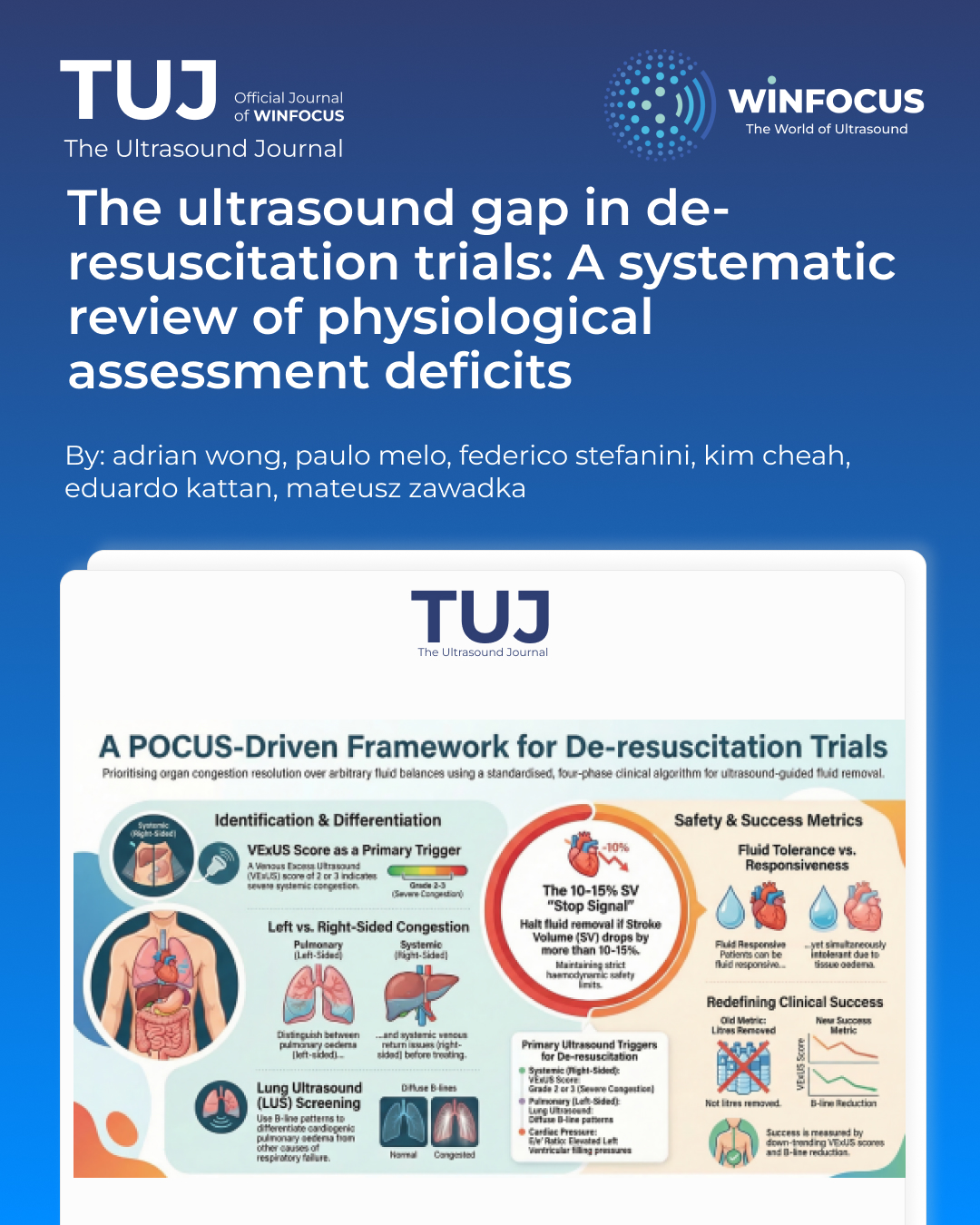
Conclusions: Current research is characterized by a significant ‘ultrasound gap,’ where the theoretical benefits of POCUS are not yet integrated into interventional trials. Future research must bridge this gap using standardized, physiology-driven protocols.
References
1. Malbrain ML, Marik PE, Witters I, Cordemans C, Kirkpatrick A, Roberts D, et al. Fluid overload, de-resuscitation, and outcomes in critically ill or injured patients: a systematic review with suggestions for clinical practice. Anaesthesiol Intensive Ther. 2014;46(5):361-80.
2. Prowle JR, Echeverri JE, Ligabo EV, Ronco C, Bellomo R. Fluid balance and acute kidney injury. Nat Rev Nephrol. 2010;6(2):107-15.
3. Hoste EA, Maitland K, Brudney CS, Mehta R, Vincent JL, Yates D, et al. Four phases of intravenous fluid therapy: a conceptual model. Br J Anaesth. 2014;113(5):740-7.
4. Bouchard J, Soroko SB, Chertow GM, Himmerlfarb J, Ikizler TA, Pagani, et al. Fluid accumulation, survival and recovery of kidney function in critically ill patients with acute kidney injury. Kidney Int. 2009;76(4):422-7.
5. Payen D, de Pont AC, Sakr Y, Spies C, Reinhart K, Vincent JL. A positive fluid balance is associated with a worse outcome in patients with acute renal failure. Crit Care. 2008;12(3):R74.
6. Silversides JA, Major E, Ferguson AJ, Mann E, McAuley D, Marshall J, et al. Conservative fluid management or deresuscitation for patients with sepsis or acute respiratory distress syndrome following the resuscitation phase of critical illness: a systematic review and meta-analysis. Intensive Care Med. 2017;43(2):155-70.
7. Messmer AS, Dill T, Müller M, Pfortmueller CA. Active fluid de-resuscitation in critically ill patients with septic shock: A systematic review and meta-analysis. Eur J Intern Med. 2023;109:89-96. doi:10.1016/j.ejim.2023.01.009
8. Malbrain MLNG, Martin G, Ostermann M. Everything you need to know about deresuscitation. Intensive Care Med. 2022;48(12):1781-6. doi:10.1007/s00134-022-06761-7
9. Ostermann M, Alshamsi F, Artigas Raventos A, Cecconi M, Ichai C, Jones C, et al. European Society of Intensive Care Medicine Clinical Practice Guideline on fluid therapy in adult critically ill patients: Part 3-fluid removal at de-escalation phase. Intensive Care Med. 2025;51(10):1749-63. doi:10.1007/s00134-025-08058-x
10. Michard F, Biais M. Rational fluid management: dissecting facts from fiction. Br J Anaesth 2012;108:369-71. doi:10.1093/bja/aer511
11. Kenworthy P, Phillips M, Grisbrook TL, Gibson W, Wood F, Edgar D. An objective measure for the assessment and management of fluid shifts in acute major burns. Burn Trauma 2018;6:3. doi:10.1186/s41038-017-0105-9
12. Messmer A, Pietsch U, Siegemund M, Buehler P, Waskowski J, Muller M, et al. Protocolised early de-resuscitation in septic shock (REDUCE): protocol for a randomised controlled multicentre feasibility trial. BMJ Open. 2023;13(9):e074847. doi:10.1136/bmjopen-2023-074847
13. Early Deresuscitation Strategy Driven by Tissue Perfusion in Renal Replacement Therapy in Patients with Acute Renal Failure (EarlyDry). ClinicalTrials.gov identifier: NCT05817539. Updated Jan 8, 2026. Accessed Feb 13, 2026. https://clinicaltrials.gov/study/NCT05817539
14. Michard F, Teboul JL. Predicting fluid responsiveness in ICU patients: a critical analysis of the evidence. Chest. 2002;121(6):2000-8.
15. Monnet X, Messina A, Greco M, Bakker J, Aissaoui N, Cecconi M, et al. ESICM guidelines on circulatory shock and hemodynamic monitoring 2025. Intensive Care Med. 2025;51(11):1971-2012. doi:10.1007/s00134-025-08137-z
16. Robba C, Wong A, Poole D, Al Tayar A, Arntfield R, Chew M, et al. Basic ultrasound head-to-toe skills for intensivists in the general and neuro intensive care unit population: consensus and expert recommendations of the European Society of Intensive Care Medicine. Intensive Care Med. 2021;47(12):1347-67. doi:10.1007/s00134-021-06486-z
17. Basmaji J, Arntfield R, Desai K, Lau V, Lewis K, Rochwerg B, et al. The Impact of Point-of-Care Ultrasound-Guided Resuscitation on Clinical Outcomes in Patients with Shock: A Systematic Review and Meta-Analysis. Crit Care Med. 2024;52(11):1661-73. doi:10.1097/CCM.0000000000006399
18. Chen Z, Han X, Liu Y, Wang M, Wang B, Wang L, et al. Ultrasound-guided fluid resuscitation versus usual care guided fluid resuscitation in patients with septic shock: a systematic review and meta-analysis. Emerg Crit Care Med 2024;4:82-9. doi:10.1097/EC9.0000000000000088
19. Beaubien-Souligny W, Rola P, Haycock K, Bouchard J, Larmarche Y, Spiegel R, et al. Quantifying systemic congestion with Point-Of-Care ultrasound: development of the venous excess ultrasound grading system. Ultrasound J. 2020;12(1):16.
20. Kattan E, Castro R, Miralles-Aguiar F, Hernández G, Rola P. The emerging concept of fluid tolerance: A position paper. J Crit Care. 2022;71:154070. doi:10.1016/j.jcrc.2022.154070
21. Koratala A, Reisinger N. Venous Excess Doppler Ultrasound for the Nephrologist: Pearls and Pitfalls. Kidney Med. 2022;4(7):100482. doi:10.1016/j.xkme.2022.100482
22. Rola P, Miralles-Aguiar F, Argaiz E, Beaubien-Souligny W, Haycock K, Karimov T, et al. Clinical applications of the venous excess ultrasound (VExUS) score: conceptual review and case series. Ultrasound J. 2021;13(1):32. doi:10.1186/s13089-021-00232-8
23. Page MJ, McKenzie JE, Bossuyt PM, Boutron I, Hoffmann TC, Mulrow CD, et al. The PRISMA 2020 statement: an updated guideline for reporting systematic reviews BMJ 2021;372:n71 doi:10.1136/bmj.n71
24. Sterne JAC, SavoviÄ J, Page MJ, Elbers RG, Blencowe NS, Boutron I, et al. RoB 2: a revised tool for assessing risk of bias in randomised trials BMJ 2019;366:l4898 doi:10.1136/bmj.l4898
25. National Heart, Lung, and Blood Institute Acute Respiratory Distress Syndrome (ARDS) Clinical Trials Network, Wiedemann HP, Wheeler AP, Bernard GR, Thompson BT, Hayden D, deBoisblanc B, et al. Comparison of two fluid-management strategies in acute lung injury. N Engl J Med. 2006;354(24):2564-75. doi:10.1056/NEJMoa062200
26. Cantarovich F, Rangoonwala B, Lorenz H, Verho M, Esnault VL; High-Dose Furosemide in Acute Renal Failure Study Group. High-dose furosemide for established ARF: a prospective, randomized, double-blind, placebo-controlled, multicenter trial. Am J Kidney Dis. 2004;44(3):402-9.
27. Mekontso Dessap A, Roche-Campo F, Kouatchet A, Tomicic V, Beduneau G, Sonneville R, et al. Natriuretic peptide-driven fluid management during ventilator weaning: a randomized controlled trial. Am J Respir Crit Care Med. 2012;186(12):1256-63. doi:10.1164/rccm.201205-0939OC
28. Hamishehkar H, Sanaie S, Fattahi V, Mesgari M, Mahmoodpoor A. The Effect of Furosemide on the Level of Neutrophil Gelatinase-associated Lipocalin in Critically Hospitalized Patients with Acute Kidney Injury. Indian J Crit Care Med. 2017;21(7):442-7. doi:10.4103/ijccm.IJCCM_93_17
29. Bagshaw SM, Gibney RTN, Kruger P, Hassan I, McAlister FA, Bellomo R. The effect of low-dose furosemide in critically ill patients with early acute kidney injury: A pilot randomized blinded controlled trial (the SPARK study). J Crit Care. 2017;42:138-46. doi:10.1016/j.jcrc.2017.07.030
30. Berthelsen RE, Perner A, Jensen AK, Rasmussen BS, Jensen JU, Wiis J, et al. Forced fluid removal in intensive care patients with acute kidney injury: The randomised FFAKI feasibility trial. Acta Anaesthesiol Scand. 2018;62(7):936-44. doi:10.1111/aas.13124
31. Semler MW, Wheeler AP, Thompson BT, Bernard G, Wiedemann H and Rice T. Impact of Initial Central Venous Pressure on Outcomes of Conservative Versus Liberal Fluid Management in Acute Respiratory Distress Syndrome. Crit Care Med. 2016;44(4):782-9. doi:10.1097/CCM.0000000000001555
32. Cinotti R, Lascarrou JB, Azais MA, Colin G, Quenot JP, Mahe PJ, et al. Diuretics decrease fluid balance in patients on invasive mechanical ventilation: the randomized-controlled single blind, IRIHS study. Crit Care. 2021;25(1):98. doi:10.1186/s13054-021-03509-5
33. Vaara ST, Ostermann M, Bitker L, Schneider A, Poli E, Hoste E, et al. Restrictive fluid management versus usual care in acute kidney injury (REVERSE-AKI): a pilot randomized controlled feasibility trial. Intensive Care Med. 2021;47(6):665-73. doi:10.1007/s00134-021-06401-6
34. Silversides JA, Fitzgerald E, Manickavasagam US, Lapinsky S, Nisenbaum R, Hemmigs N, et al. Deresuscitation of Patients with Iatrogenic Fluid Overload Is Associated with Reduced Mortality in Critical Illness. Crit Care Med. 2018;46(10):1600-7. doi:10.1097/CCM.0000000000003276
35. Wichmann S, Schønemann-Lund M, Perner A, Itenov T, Lange T, Gluud C, et al. Goal-directed fluid removal with furosemide versus placebo in intensive care patients with fluid overload: A randomised, blinded trial (GODIF trial-First version). Acta Anaesthesiol Scand. 2023;67(4):470-8. doi:10.1111/aas.14196
36. Chen C, Kollef MH. Targeted Fluid Minimization Following Initial Resuscitation in Septic Shock: A Pilot Study. Chest. 2015;148(6):1462-9. doi:10.1378/chest.15-1525
37. Castro R, Born P, Roessler E, Labra C, McNab P, Bravo S, et al. Preload responsiveness-guided fluid removal in mechanically ventilated patients with fluid overload: A comprehensive clinical-physiological study. J Crit Care. 2024;84:154901. doi:10.1016/j.jcrc.2024.154901
38. Arabi YM, Belley-Cote E, Carsetti A, De Backer D, Donadello K, Jufffermans NP, et al. European Society of Intensive Care Medicine clinical practice guideline on fluid therapy in adult critically ill patients. Part 1: the choice of resuscitation fluids. Intensive Care Med. 2024;50(6):813-31. doi:10.1007/s00134-024-07369-9
39. Mekontso Dessap A, AlShamsi F, Belletti A, De Backer D, Delaney A, Moller MH, et al. European Society of Intensive Care Medicine (ESICM) 2025 clinical practice guideline on fluid therapy in adult critically ill patients: part 2-the volume of resuscitation fluids. Intensive Care Med. 2025;51(3):461-77. doi:10.1007/s00134-025-07840-1
Downloads
Issue
Section
License
This is an Open Access article distributed under the terms of the Creative Commons Attribution License (https://creativecommons.org/licenses/by-nc/4.0) which permits unrestricted use, distribution, and reproduction in any medium, provided the original work is properly cited.
Authors retain the copyright for their published work. No formal permission will be required to reproduce parts (tables or illustrations) of published papers, provided the source is quoted appropriately and reproduction has no commercial intent.
How to Cite